COLLABORATION WITH

Data Science : Microsoft Azure Artificial Intelligence Fundamentals

Duration: 2 Weeks
Price: Rs 6499 (+18%GST)

Exam Objective Register Now
Data Science : Microsoft Azure Artificial Intelligence Fundamentals
  1. 1. Self Paced ~ 18 Hrs
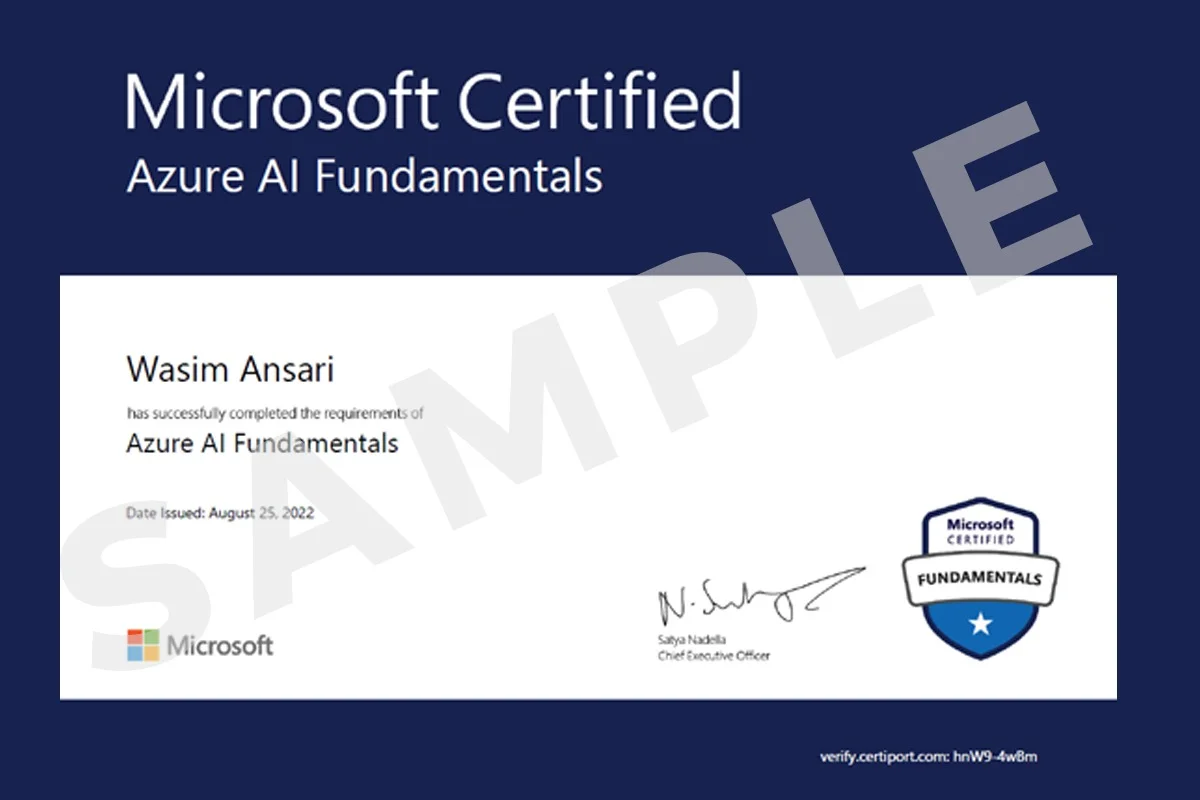
  2. 2. MCF Certificate on successful completion
  3. 3. Unlimited lifetime access to the course

Earning Potential
  1. 1. Azure DevOps engineer: $126,096 on an average annually.
  2. 2. Azure cloud engineer: $130,233 on an average annually.
  3. 3. Azure data engineer: $122,746 on an average annually.
What will you learn?
  1. 1. Python for Data Science
  2. 2. Introduction to Statistics
  3. 3. Theoretical knowledge and practical aspects of Machine Learning
  4. 4. Basic knowledge of Artificial Intelligence
  5. 5. Neural Networks and working
  6. 6. LSTM and sequence prediction
Skills Gained
  1. 1. Gain knowledge of common ML and AI workloads and how to implement them on Azure.
  2. 2. Associate or Azure AI Engineer Associate
  3. 3. Azure AI Fundamentals can be used to prepare for other Azure role-based certifications like Azure Data Scientist

Our Pricing Plan

Rs 6,499

(+18%GST)

  • Self Paced
  • Microsoft Certificate
certi-img
certi-img
certi-img
certi-img

Program Lessons

Chapter 1- Describe types of core data workloads
  • 1.1 Describe batch data
  • 1.2 Describe streaming data
  • 1.3 Describe the difference between batch and streaming data
  • 1.4 Describe the characteristics of relational data
Chapter 2 - Describe data analytics core concepts
  • 2.1 Describe data visualization (e.g., visualization, reporting, business intelligence (BI))
  • 2.2 Describe basic chart types such as bar charts and pie charts
  • 2.3 Describe analytics techniques (e.g., descriptive, diagnostic, predictive, prescriptive, cognitive)
  • 2.4 Describe ELT and ETL processing
  • 2.5 Describe the concepts of data processing
Chapter 3 - Describe relational data workloads
  • 3.1 Identify the right data offering for a relational workload
  • 3.2 Describe relational data structures (e.g., tables, index, views)
Chapter 4 - Describe relational Azure data services
  • 4.1 Describe and compare PaaS, IaaS, and SaaS solutions
  • 4.2 Describe Azure SQL database services including Azure SQL Database, Azure SQL Managed Instance, and SQL Server on Azure Virtual Machine
  • 4.3 Describe Azure Synapse Analytics
  • 4.4 Describe Azure Database for PostgreSQL, Azure Database for MariaDB, and Azure Database for MySQL
Chapter 5 - Identify basic management tasks for relational data
  • 5.1 Describe provisioning and deployment of relational data services
  • 5.2 Describe method for deployment including the Azure portal, Azure Resource Manager templates, Azure PowerShell, and the Azure command-line interface (CLI)
  • 5.3 Identify data security components (e.g., firewall, authentication)
  • 5.4 Identify basic connectivity issues (e.g., accessing from on-premises, access with Azure VNets, access from Internet, authentication, firewalls)
  • 5.6 Identify query tools (e.g., Azure Data Studio, SQL Server Management Studio, sqlcmd utility, etc.)
Chapter 6 - Describe query techniques for data using SQL language
  • 6.1 Compare Data Definition Language (DDL) versus Data Manipulation Language (DML)
  • 6.2 Query relational data in Azure SQL Database, Azure Database for PostgreSQL, and Azure Database for MySQL
Chapter 7 - Describe non-relational data workloads
  • 7.1 Describe the characteristics of nonrelational data
  • 7.2 Describe the types of non-relational and NoSQL data
  • 7.3 Recommend the correct data store
  • 7.4 Determine when to use non-relational data
Chapter 8 - Describe non-relational data offerings on Azure
  • 8.1 Identify Azure data services for nonrelational workloads
  • 8.2 Describe Azure Cosmos DB APIs
  • 8.3 Describe Azure Table storage
  • 8.4 Describe Azure Blob storage
  • 8.5 Describe Azure File storage
Chapter 9 - Identify basic management tasks for nonrelational data
  • 9.1 Describe provisioning and deployment of non-relational data services
  • 9.2 Describe method for deployment including the Azure portal, Azure Resource Manager templates, Azure PowerShell, and the Azure command-line interface (CLI)
  • 9.3 Identify data security components (e.g., firewall, authentication)
  • 9.4 Identify basic connectivity issues (e.g., accessing from on-premises, access with Azure VNets, access from Internet, authentication, firewalls)
  • 9.5 Identify management tools for nonrelational data
Chapter 10 - Describe analytics workloads
  • 10.1 Describe transactional workloads
  • 10.2 Describe the difference between a transactional and an analytics workload
  • 10.3 Describe the difference between batch and real time
  • 10.4 Describe data warehousing workloads
  • 10.5 Determine when a data warehouse solution is needed
Chapter 11 - Describe the components of a modern data warehouse
  • 11.1 Describe Azure data services for modern data warehousing such as Azure Data Lake, Azure Synapse Analytics, Azure Databricks, and Azure HDInsight
  • 11.2 Describe modern data warehousing architecture and workload
Chapter 12 - Describe data ingestion and processing on Azure
  • 12.1 Describe common practices for data loading
  • 12.2 Describe the components of Azure Data Factory (e.g., pipeline, activities, etc.)
  • 12.3 Describe data processing options (e.g., Azure HDInsight , Azure Databricks, Azure Synapse Analytics, Azure Data Factory)
Chapter 13 - Describe data visualization in Microsoft Power BI
  • 13.1 Describe the role of paginated reporting
  • 13.2 Describe the role of interactive reports
  • 13.3 Describe the role of dashboards
  • 13.4 Describe the workflow in Power BI

If you haven’t heard, Onestoptech is making major headlines!

How onestoptech.org Is Closing the Skills Gap.

Empowering Students Nationwide with Industry-Aligned Programs, Hands-On Project Experience, and Globally Recognized Certifications. Bridging the Gap Between Academic Learning and Real-World Professional Demands.

Shashwat Dubey's Strategic Leadership at Onestoptech:

Revolutionizing the Tech Landscape by Merging Traditional Development Practices with Modern AI Solutions for Enhanced Productivity. His Vision Is Transforming How India's Next Generation of Developers Learn and Grow.

Onestoptech Makes Tech Education Accessible Across India:

Offering Affordable, Comprehensive Programs in Java, AI, Data Science, and More to Students from All Backgrounds. Enabling Young Professionals to Build Careers in the Most In-Demand Fields of the Digital Economy.

Onestoptech Earns Recognition as an Innovative EdTech Platform:

Delivering Structured Learning Pathways That Take Students from Zero to Job-Ready in Just Months. Its Unique Blend of Technology, Mentorship, and Portfolio Building Is Redefining What EdTech Can Achieve.

Onestoptech Brings Tech Training to Every Corner of India:

Offering Inclusive Learning Programs That Break Barriers of Geography and Economic Background Across the Country. Students from Tier 2 and Tier 3 Cities Are Now Building Successful Careers...

Onestoptech's Rapid Growth Is Drawing Worldwide Attention:

With a Curriculum Designed Around Real Industry Needs and Mentorship from Seasoned Professionals, Onestoptech Is Producing Job-Ready Talent at Scale. The Platform's Impact Is Being Noticed by Educators and Investors Across the Globe.

Onestoptech Sets a New Global Benchmark in Tech Education:

Training Students in Internationally Recognized Skills Like Java, Cloud Computing, and AI-Powered Development at Scale. Graduates Are Securing Opportunities with Leading Companies Both in India and Abroad.

Onestoptech's Model Addresses India's Critical Tech Skills Gap:

Training Thousands of Students in High-Demand Areas Such as Java, Data Science, Cloud Engineering, and AI-Powered Development. Its Impact Is Being Felt Across Startups....